
Learn How to Engage with Congressional Offices about the Census – Read the Manual Here.
CENSUS RESOURCE | LUCA | September 2026
LUCA - The Local Update of Census Address
LUCA is a once-a-decade program that gives local governments the opportunity to review and correct the address records the Census Bureau uses to conduct the census. More accurate addresses mean more households reached, which may help reduce the risk of an undercount.
What is LUCA?
LUCA — the Local Update of Census Addresses — is the only once-a-decade chance for local governments to review, correct, and add addresses to the Census Bureau’s confidential address list before the 2030 count begins. The program is authorized under the Census Address List Improvement Act of 1994 (Public Law 103-430). Learn more from the Census Bureau
Why LUCA Matters: The Link Between Addresses and Undercounts
The Census Bureau relies primarily on its Master Address File to mail invitations and conduct outreach. If a home is missing or incorrectly mapped in the database, its residents may not receive a census form or follow-up outreach.
In a 2023 study, the National Academies of Sciences, Engineering, and Medicine found that the quality of the decennial census is closely tied to the quality of the address list: “Quality of the decennial census as a 100 percent sample of the population is inextricably linked to the quality of the U.S. Census Bureau’s geographic resources and, in particular, the address list used to mount census data-collection efforts.” Low LUCA participation may increase the risk of an undercount. Read the full NAS study (Assessing the 2020 Census, Sullivan & Cork, eds.).
How Texas Fared in Past LUCA Operations
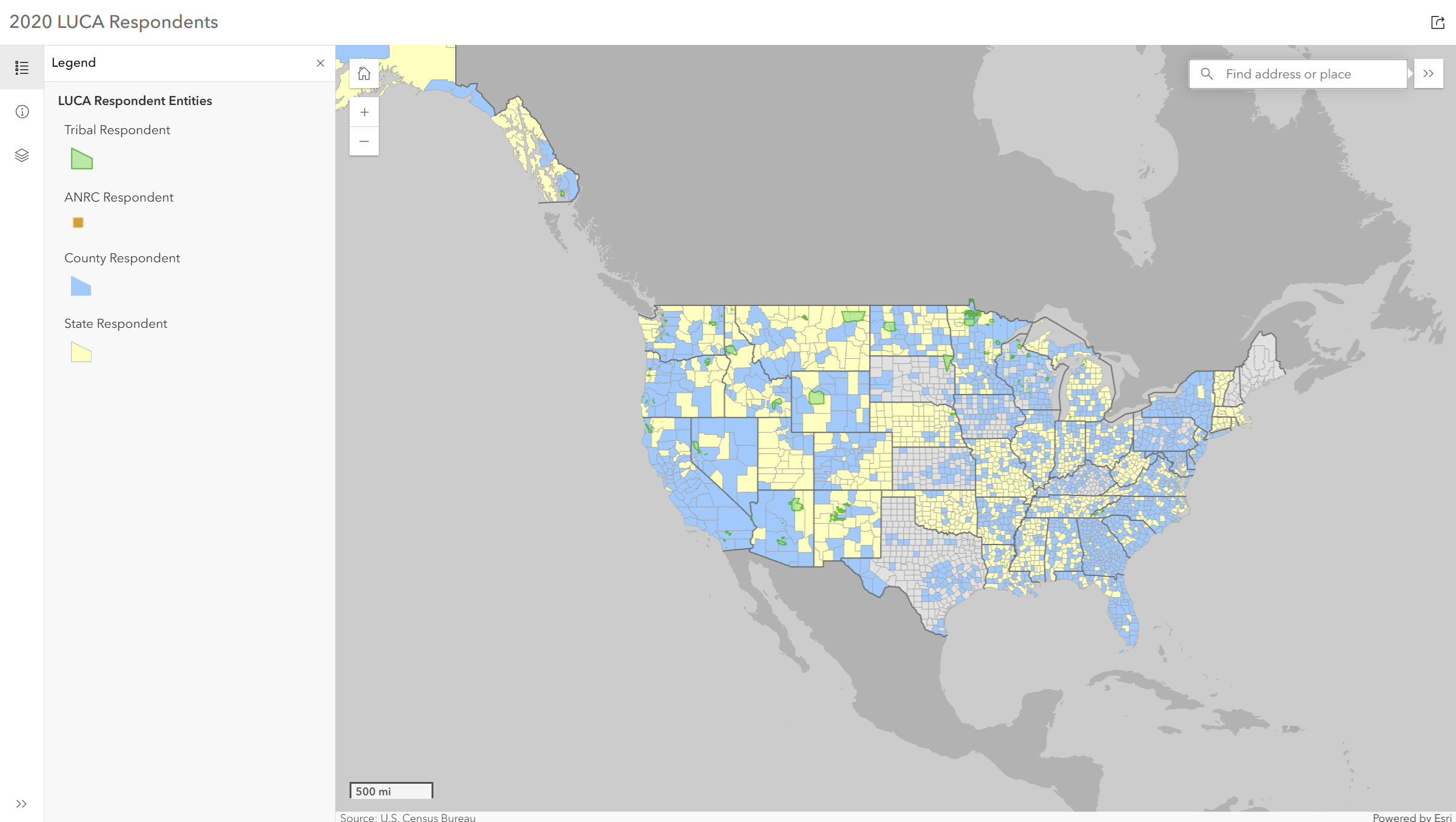
Out of 254 counties in Texas — 191 of which are classified as rural — only 56 participated in the 2020 Census LUCA program. See the LUCA response map.
In the 2020 Census, Texas experienced an estimated net undercount of 547,968 residents, which potentially contributed to a $25.1 billion loss in federal funding for health, education, and infrastructure programs over the decade. See our funding implications research. Limited LUCA participation across Texas counties may have been a contributing factor to the undercount, as households not on file may have been missing from outreach efforts.
The Opportunity: If Texas Participates, Texas Wins
Ensuring more complete and correct addresses through LUCA could help every residential property, including nonstandard, rural, or multi-family housing be enumerated during the 2030 Census potentially resulting in a more complete count.
Updating local address databases for LUCA may also yield improvements to local infrastructure including 9-1-1 emergency response routing, public safety mapping, and municipal planning services.
The Census Bureau has also made several changes for 2030 that could make participation more accessible than in past cycles, including:
- Earlier access to Address Count Listing Files
- A fully digital submission process (no paper materials)
- Improved web-based tools, including address-matching service
- A review window extended from four months in 2020 to up to six months in 2030
- A more data-driven, coverage based approach to review
Proof of Success: The Hidalgo Case Study
TxCI performed a case study of Hidalgo county to explore what participation looked like on the ground.
Local Collaboration: County officials paired local 9-1-1 address records with on-the-ground validation from community-based organizations to help resolve address discrepancies in unmapped border communities.
Measurable Data Improvement (Pueblo de Palmas): In the six-square-mile Pueblo de Palmas area, Hidalgo County identified and added 199 previously unrecorded addresses. Research suggests that up to 70% of those addresses were likely included in the 2020 Census enumeration as a result of the county’s LUCA submission.
Countywide Impact: Across all of Hidalgo County, local LUCA efforts identified approximately 10,000 additional households that federal master files had missed, which may have improved demographic accuracy and local representation. Read the full case study.
Building Best Practices: Rural East Texas Pilot
Rural counties face unique hurdles, including nonstandard housing, long private drives, and limited local GIS capacity.
TxCI is currently testing a collaborative model in East Texas with a regional council of governments and county leadership, cross-referencing local E-911 and utility data against Census Bureau block-level counts to conduct targeted field verification in a rural county.
Lessons learned from this pilot are being compiled into a repeatable LUCA roadmap and best-practice guide that could be scaled to counties across Texas.
Who Can Participate
The highest elected or appointed official from each eligible government including states, counties, cities, townships, and federally recognized Tribal Nations with a reservation and/or off-reservation trust lands will receive an invitation to participate. They can designate a representative, such as an employee, intern, contractor, or member of a community-based organization, college, or university.
Timeline

- Now – May 2027: Pre-LUCA preparation: governments can begin building their address data lists now.
- May – August 2027: LUCA Prep Phase: registration, account setup, block-level address count review, and training (submissions not yet accepted).
- October 2027 – March 31, 2028: LUCA Review Phase: address-level review and official submission. The Census Bureau recommends starting the registration process by February 4, 2028.
- March 2029: Feedback & Appeal: jurisdictions receive address-level feedback and have 60 days to appeal to the Office of Management and Budget.
- September 2029: Program closeout.
How to Prepare Now
Communities can start building address data lists (911 addresses, local government records, permits) and identify staff or contractors with the technical capacity to compare their data against the Census Bureau’s Address Count Listing Files. The Bureau’s Participant Address List Template and Guide to Comparing Address Counts by Block are useful starting points (see Resources below).
Reach Out to Us
FAQ
Who can participate in LUCA?
The highest elected or appointed official of any eligible tribal, state, or local government, or someone they designate to represent their jurisdiction.
When does LUCA registration begin and end?
Registration and training run from May through August 2027, with the Census Bureau recommending governments start the process by February 4, 2028 at the latest, ahead of the March 31, 2028 submission deadline.
We don't have the staff or resources to participate right now. How can we still be involved?
Local governments are encouraged to collaborate with a larger government, such as their county or state, rather than registering separately. The larger government can register, name a LUCA Liaison, and add other jurisdictions as LUCA Reviewers — which can also reduce duplicated effort and cost for everyone involved.
We participated in the 2020 LUCA cycle. Do we need to participate again for 2030?
Yes, a lot can change between census cycles. New housing built since 2020, units not visible from the street, and apartments added to larger buildings are exactly the kind of gaps LUCA is designed to catch, so participating again may add real value even for governments that reviewed their addresses last time.
Can we report address problems now, before LUCA officially opens?
Not yet. The Census Bureau only accepts LUCA submissions during the Review phase, from October 2027 through March 2028. Preparing now (building your address list, reviewing current data) puts you in a strong position once that window opens.
Source: U.S. Census Bureau, 2030 LUCA Frequently Asked Questions (June 2026).