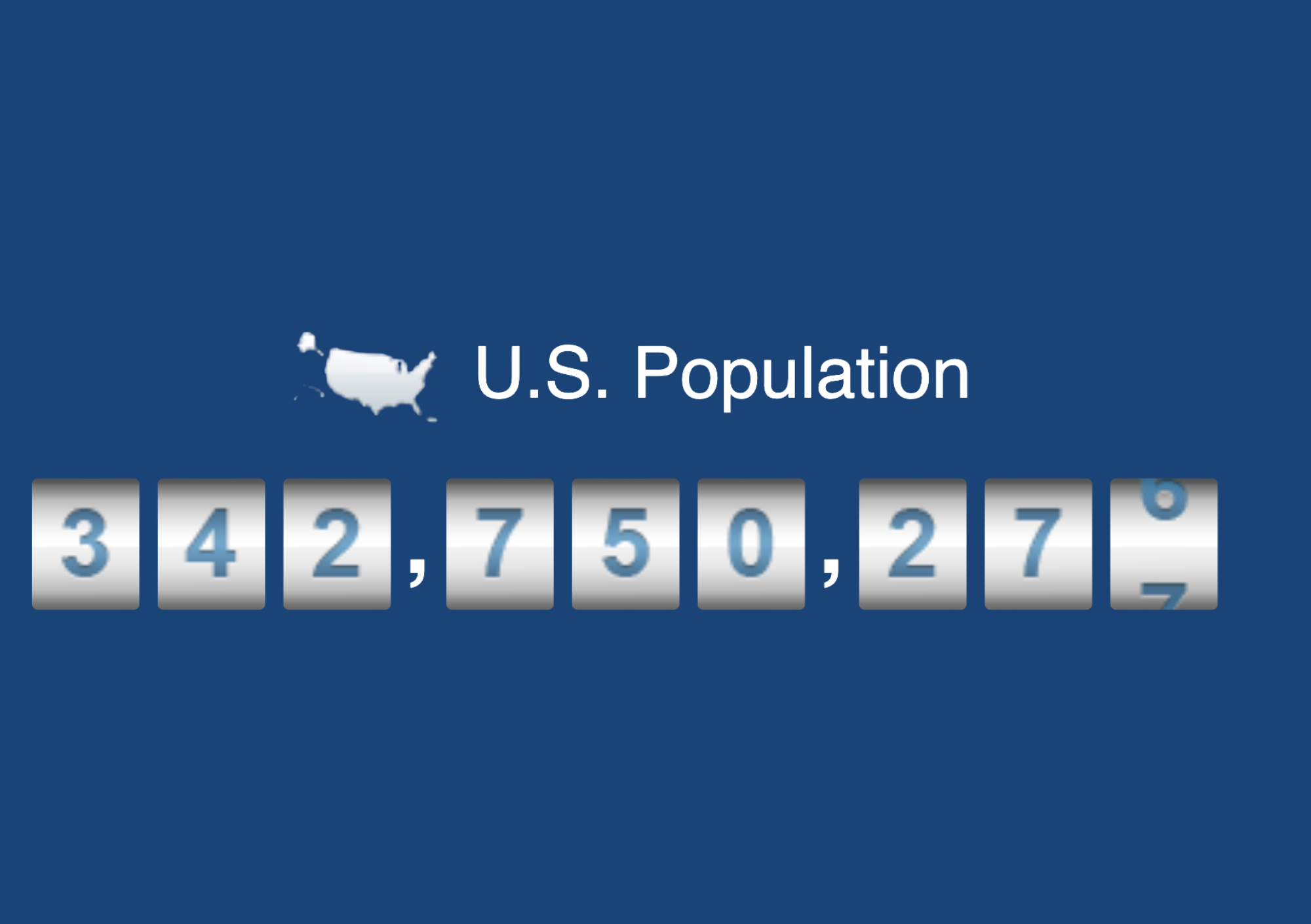
Image from The Census Bureau’s U.S and World Population Clock
When I was younger, I never truly imagined the number of people in the world, the country, or even my city. I mean, have you ever tried to picture the size of a room required to fit everyone? My world always felt quite small–just me, my family, and my friends, all in one place. Growing up, learning that my city was home to over a half a million people was already hard to grasp, so truly understanding how many people there are in the world didn’t come until later. Being from a small place like Oklahoma (and not really vacationing much) played into this as well, limiting my grasp of just how many people are in this world.
As time went on, though, I began to explore and see how many people are really out there. I went to summer programs in different states, moved to California for college, and studied abroad in Europe, encountering so many different people in so many different places. On top of these encounters, there are resources like the World Population Clock from The Census Bureau that displays the live count of people all over the globe, increasing every second, adding a shocking number to what I started to experience. After all this, I began to wonder: How could we be so sure that millions of people are supported in the ways they should be, guaranteeing better lives for as many people as possible?
While the direct answer to that question is unknown, there is one tool I didn’t think would be so important in searching for a solution: the census. I’ve always known what the census was, but I never knew what it was really used for; I always just assumed it was to keep track of people being born, people dying, people getting older, population growth, and so on. These trends seemed like nice data to have, but I could never imagine how they could benefit, well, everyone. At least, not until I started my internship with the Texas Census Institute (TxCI).
As a Public Policy Analysis major at Pomona College, my main goal has always been to help others through policy, and just looking at TxCI’s name, I figured it was a place I could inch closer to that goal. However, even after just a quick-look at their research, I realized just how crucial census data really are. From health care, to infrastructure, to education, I quickly learned how much federal funding relies on accurate census data to distribute complete funding to communities.
But what struck me most was the negative impact of an inaccurate census count. While Texas is quite a large state, over 550,000 Texans going unaccounted for in the 2020 Census is jarring, to say the least. I thought back to communities like mine that may not have gotten the resources they needed, all because they were missed during the 2020 Census. Reading that Texas lost out on billions of dollars over the next decade after the 2020 undercount, as well as an additional seat in the House of Representatives, was more than enough to convince me how important this work really was. I may not be from Texas (although, Oklahoma is pretty close…), but just imagining everything the state lost out on was enough to motivate me to work for TxCI. I feel extremely fortunate for the opportunity to help others in a way that feels impactful.
Thankfully, I made my passion clear, and I am now a part of TxCI’s first ever Intern Cohort.